Gratitude practices are often recommended as a way to improve mental wellbeing yet when I tried them in the past, I never really connected with them. A common example given by mindfulness teachers is to think about people involved in building reservoirs, installing pipework, operating water treatment facilities, installing and repairing taps, all to enable us to have fresh running water on demand. I like the idea of thinking about how everything is interconnected and being grateful for others who have made my life better, rather than taking this for granted. I therefore incorporated gratitude for plumbing into a daily practice of mentally listing things for which I am grateful. My husband doing the washing up also regularly featured on my list. I am genuinely thankful when he does it; I hate coming into a messy kitchen with no surface space to do anything and utensils not clean and available for use. However, this gratitude practice failed to warm my cockles. Maybe the unpleasantness of a messy kitchen is a stronger sensation than the pleasantness of a clean and tidy one! Whatever the reason, it felt like a cognitive exercise that failed to engage my emotions. It was a practice I quickly abandoned.
Last year, I came across a different approach while reading “Deeper mindfulness” by Mark Williams and Danny Penman[1]. In this book the authors share their Feeling Tone programme. As part of the programme, participants are encouraged to notice the feeling tone of different moments during the day. Are they pleasant, unpleasant or neutral? This question is not intended to illicit cognitive judgements but to help us identify reactions that naturally arise in us as we experience life. We have evolved to approach pleasant things and avoid unpleasant things and so our brains automatically register a felt sense of each moment. However, this often happens subconsciously. If we remain unaware of feeling tones they can lead to a cascade of reactions that influence our mood without us realising. The programme includes meditations to help us practise becoming aware of feeling tones moment-by-moment, so we can become more aware of them in our daily lives. Greater awareness gives greater choice about how to respond, enabling us to stop emotional reactions from escalating.
The programme includes a guided ten-finger gratitude meditation (although I see it more as an exercise than a meditation). Counting on our fingers, we are invited to identify ten things we are grateful for. While water in taps is given as an example, the exercise is introduced in the context of remembering pleasant moments that occurred during the day. Suggestions of how to do this include thinking through the day chronologically to recall such moments or simply allowing them to come to mind naturally. We are advised to identify ten things to encourage noticing of small moments we may otherwise overlook. An experience such as an enjoyable walk can be broken down into several pleasant moments. I might feel uplifted by the general sunshine and blue sky or feel grateful I got out of the house to go for a walk, whatever the weather. I may savour feeling the warmth of the sun on my legs, enjoy observing specific flowers, squirrels or birds and appreciate invisible birdsong.
Having felt ill during the day, I have gone to bed with a prediction that I will struggle to remember ten pleasant moments but been surprised they came easily. Moments such as seeing my husband smile, being made a cup of tea, eating something tasty or admiring the cuteness of our cat. Such memories can puncture the stories we tell ourselves about what has happened or how we are, enabling a greater recognition of the nuances in our experience.
The day our water was a weak dribble first thing in the morning and then went off completely, I was relieved and grateful to see a water tanker parked at the bottom of my street when I arrived home in the evening and found we had running water again. My felt sense of gratitude remained, even as the tanker continued its noisy non-stop pumping for at least 24 hours straight and I was on the verge of having to leave the house just to get away from it. Having drinkable water featured in my gratitude practice for several days as the tanker came and went, especially as a lot of other houses in the local area were affected by a lack of water and/or discoloured water for about a week. I had an emotional connection to the clear water running from my taps until this resumption of service was absorbed back into the normality of life.
I have done this pleasant moment gratitude practice every night before I go to sleep for almost a year. It does generate a warm glow at the end of the day, even when I am too tired to think of ten things. Focusing on pleasant feelings and experiences has also had a positive impact on my general mood.
Early this year, I started reading Nature’s Calendar[2], a book which splits the year into 72 microseasons. For each microseason, the reader is encouraged to focus on a specific change in nature. The dates attached to each microseason are less important than bringing an attitude of curiosity, attention and discovery to what we see around us as the year progresses. As a result of my reading, I have noticed things for the first time and taken time to observe them slowly and ask myself questions. What kind of tree is this? How are these leaves coming out of their buds? What is the pattern of the buds on these twigs? As leaves started emerging, I noticed that lots of trees have flowers. We don’t have to wait for the more famous blossoms to bloom; Hawthorn, Cherry and Apple are preceded by Blackthorn. Less conspicuous Sycamore flowers emerge even earlier. It is easy to miss small white Holly flowers and delicate Maple flowers. We can remain oblivious to more obvious flowers, on trees such as Whitebeam, if we rarely look up.
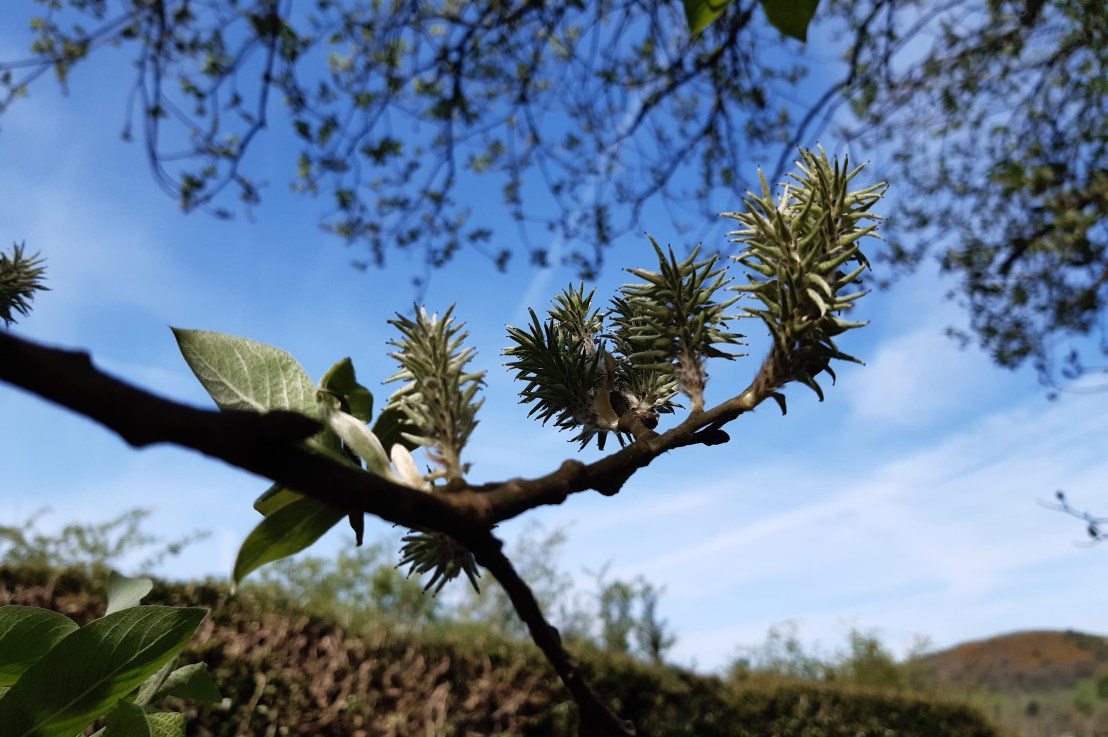
While writing this blog, I began wondering how the spiky protuberances on pine trees were going to transform and how cones would begin to take shape. With such noticing and questioning, I feel a gentle sense of wonder I have not felt before when walking in nature. And it arises naturally. I have not set an intention to seek out and only attend to pleasant aspects of the here and now. It is not something that takes cognitive effort. The preponderance of pussy willow trees along the Peak District’s Monsal Trail caught my eye with their spiky female catkins (very unlike the oval furry-grey male catkins). This led to me noticing these trees, which I had previously overlooked, on my regular walks closer to home. Once pollinated, I was intrigued to observe the cobwebby seeds that cling to them then drift through the air, even though I did not find this an inherently pleasant sight.
I believe the power of my present gratitude practice lies in both the increased awareness of pleasant feeling tones as they happen and the process of recalling them afterwards. Attending to detailed changes in nature elicits feelings of wonder and curiosity in the moment. Then recalling these (and other) pleasant feeling tones at the end of the day re-engages my emotions, generating a felt sense of gratitude. In all probability, both parts of this practice strengthen pathways in my brain that attend to pleasantness, counter-balancing the mind’s natural bias to focus on unpleasant experiences and memories.
[1] Williams, M and Penman, D (2023), Deeper Mindfulness; The new way to rediscover calm in a chaotic world. Piatkus.
[2] Chapman, K, Ellender, L, Jaines, R and Warren, R (2023). Nature’s Calendar: The British Year in 72 seasons. Granta.
Blog image: Female pussy willow catkins, photo taken by Anna Whitehead.

