
Is it always stressful to work on something you really care about?
Since I learned about the three emotion regulation systems (the drive, threat and soothing systems) and their role in my experiences of stress, this is a question I have asked myself.
As described in my earlier blog “From anxiety to resilience”, the drive system is associated with motivation and energy. When I experienced my most severe work-related stress, I was extremely passionate and focused on my work. Striving to successfully deliver project aims and make a difference, my drive system was in over-drive. I cared deeply about the project I was working on as we had a real opportunity to significantly improve outcomes for people with disabilities. When my goals and desires for project success were jeopardised, this activated my threat system, creating stress.
My identity and self-worth became entangled with project success, which further activated my drive system. This was fuelled by the underlying belief that I needed to do a good job. Nonetheless, if I had cared less about the aims of the project, I would have been less stressed.
The announcement that I would have to reapply for my job further activated my threat system. I was also unaware of my soothing system and paid no attention to my wellbeing. My drive and threat systems therefore grew disproportionately until the three systems were significantly out of balance.
So, how much did my passion for what we were doing contribute to my stress levels? If I were to become passionate about work in the future, would this inevitably lead to anxiety and stress?
Mindfulness advocates an attitude of non-striving, being in the moment and letting go. Through learning about these attitudes, I realised enjoying the journey and not being so attached to outcomes would be beneficial for my mental wellbeing. Even when projects don’t go to plan and desired results are not delivered, value and benefits can still be created on the way. These are not always immediately visible. However, taking a step back to reflect on the process with others can help us recognise progress and things that have worked well.
Psychologists also distinguish between “harmonious passion” and “obsessive passion”. An obsessive passion is one your mood and self-esteem depend on, which is associated with burnout and anxiety. In contrast, a harmonious passion complements other important activities in your life and is associated with positive mood.[1] Keeping my work in perspective so it doesn’t define my identity and determine my self-worth is therefore important.
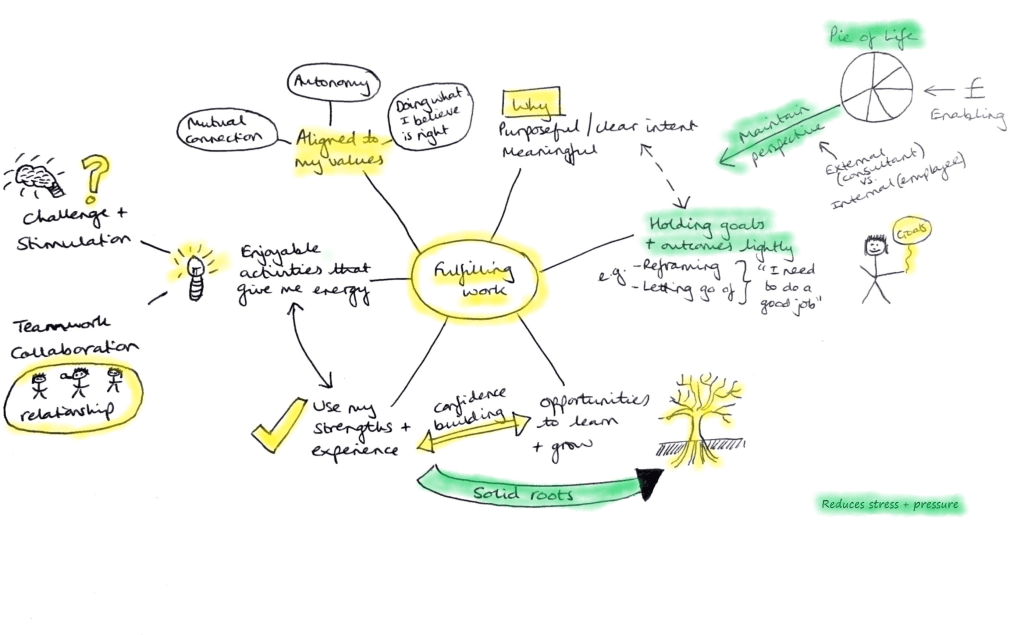
Practically, maintaining a focus on the different elements of my “pie of life” enables me to keep work in perspective. In addition, noticing when the ingrained, habitual thought “I need to do a good job” kicks in, I can create some distance from the thought and choose how to respond. Sometimes observing that it has come into play is enough to enable me to let it go. Sometimes reframing it is helpful. For example, when training as a coach, I reframed my desire to be a good coach into an intention to create effective coaching relationships. Letting go and reframing both stop me taking too much responsibility for trying to ensure success, reducing the stress and pressure I feel while also empowering others. In reality, making progress and creating value is a shared endeavour that I cannot achieve on my own.
I want to avoid my stress levels increasing to a point where they start to interfere with my ability to be at my best. I therefore find it useful to remember that anxiety is a useful message and so worrying about how to minimise it is not helpful. This emotion often highlights that there is something in my work that it would be useful for me to focus on. For example, there may be actions I can take to help surface and resolve issues, or to reduce the likelihood of future issues emerging. If I listen to the message and then decide how to respond, my anxiety need not escalate into stress.
Last year, I found myself undertaking some work as an external consultant. It was not work I had been looking for, but it found me. I was contacted by a former colleague asking if I would help him and feeling confident that I could add value, I agreed. It came as somewhat of a surprise to discover that I was actually enjoying the work! I had thought it wasn’t a direction I wanted to go in, that I had had enough of facilitating change management and service redesign projects.
On noticing my enjoyment, I wanted to explore it further; what was it about the work that I was enjoying? What was giving me energy? I began to create a mind-map, which I iterated on as the work progressed. This helped me identify the things that were fuelling my enjoyment. From this, I developed the following “recipe” for what brings me happiness at work, which includes elements that reduce stress and pressure:
What makes work fulfilling for you?
What gives you energy?
[1] BPS research digest – “How To Find Your Calling, According to Psychology” (November 15, 2018): https://digest.bps.org.uk/2018/11/15/how-to-find-your-calling-according-to-psychology/
Blog post photograph by Gloria Williams from Pixaby
 Seeing life's tapestry